
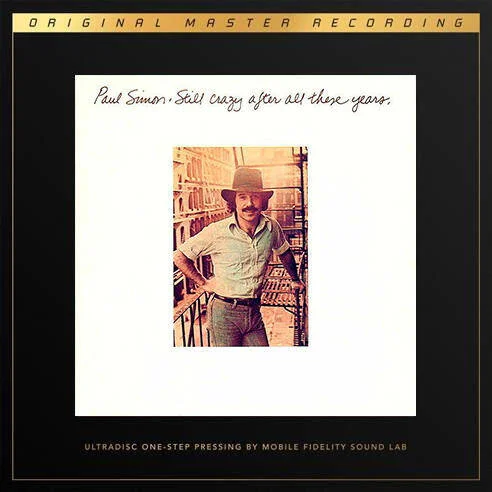
Description
Exorcising personal demons and romantic trauma, Simon frames Still Crazy After All These Years as a post-divorce statement yet retains cutting humor and lighthearted cynicism that make every song universally appealing. Musically, Simon steps back from the eclecticism of his prior album and cozies up to a jazz-pop sound steeped in subtle horns and strings. A plethora of catchy hooks do the rest and make this another classic entry in Simons history.
The rich solo catalog of Paul Simon began with several classic studio albums released from 1972 to 1975. Like his seminal Simon & Garfunkel recordings, Simons first solo albums were also released on Columbia Records. Paul Simon (1972), There Goes Rhymin Simon (1973) and Still Crazy After All These Years (1975) now return to the Columbia imprint for the first time since their original vinyl releases.
During his distinguished career, Simon has been the recipient of many honors and awards. A recipient of the Grammy Lifetime Achievement Award, Simon has won 12 Grammys including three Albums of the Year. Simon is a member of The Songwriters Hall of Fame, a recipient of their Johnny Mercer Award and is in the Rock n Roll Hall of Fame both as a member of Simon and Garfunkel and as a solo artist. He was a recipient of The Kennedy Center Honors in 2003 and was named as one of Time Magazines 100 People Who Shape Our World in 2006. In 2007, Simon was awarded the first annual Library of Congress Gershwin Prize for Popular Song.
Mobile Fidelity UltraDisc One-Step and Why It Is Superior
Instead of utilizing the industry-standard three-step lacquer process, Mobile Fidelity Sound Labs new UltraDisc One-Step (UD1S) uses only one step, bypassing two processes of generational loss. While three-step processing is designed for optimum yield and efficiency, UD1S is created for the ultimate in sound quality. Just as Mobile Fidelity pioneered the UHQR (Ultra High-Quality Record) with JVC in the 1980s, UD1S again represents another state-of-the-art advance in the record-manufacturing process. MFSL engineers begin with the original master tapes and meticulously cut a set of lacquers. These lacquers are used to create a very fragile, pristine UD1S stamper called a convert. Delicate converts are then formed into the actual record stampers, producing a final product that literally and figuratively brings you closer to the music. By skipping the additional steps of pulling another positive and an additional negative, as done in the three-step process used in standard pressings, UD1S produces a final LP with the lowest noise floor possible today. The removal of the additional two steps of generational loss in the plating process reveals tremendous amounts of extra musical detail and dynamics, which are otherwise lost due to the standard copying process. The exclusive nature of these very limited pressings guarantees that every UD1S pressing serves as an immaculate replica of the lacquer sourced directly from the original master tape. Every conceivable aspect of vinyl production is optimized to produce the most perfect record album available today.

Reviews
There are no reviews yet.