Description
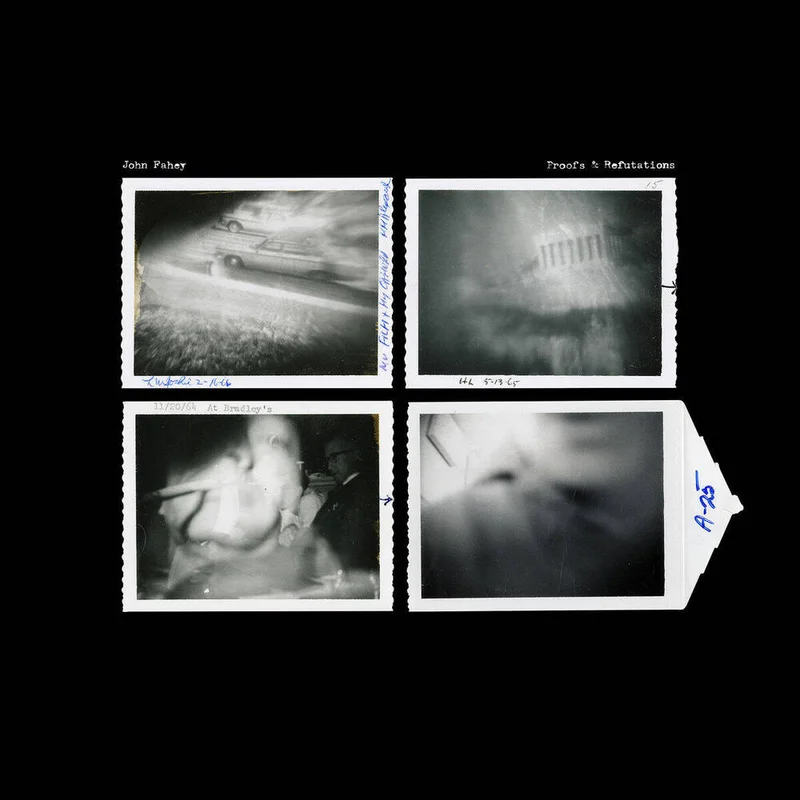
Recorded in 1995 and 1996, mostly in John Faheys room at a Salem, Oregon boarding house, the performances on Proofs & Refutations prefigure the ornery turn of the page that marked Faheys final years, drawing another enigmatic rabbit from his seemingly bottomless musical hat.
Cloaked in the language of dogma what is he proving? refuting? this is Fahey dancing a jig in the Duchampian gap, jester cap bells a-jingling. True believers? Hes got something for you: an uncompromising vision that you can sneer at (guy cant play anymore and refuses to concede!) or embrace as evidence of his genius (the reinventor does it again!). Skeptics? Hes there with you, too: sending up the fallacy of certitudes altogether. Institutions, systems, accepted wisdoms. Heroes. Alternative facts, indeed.
Right out the gate, Fahey re-materializes before us, somewhere between Oracle of Delphi and Clown Prince at Olympus. Mounting a thundering dialectic from on high, All the Rains resembles nothing else in his extensive discography betraying roots in everything from Dada to Episcopal liturgical chant and contains nary a plucked guitar note. You cant fool him! When the lap steel of yore appears on F for Fake, it serves more as soundbed for an extended sequence of vocal improvisations, running the gamut from wordless Bashoian caterwauling to free-form (but decidedly fake) Tuvan, even revealing a burnished falsetto in the process.
Fahey takes on a different kind of provocation in the two acoustic guitar- based tracks closing Side 1 Morning parts 1 and 2 the first of four recordings in this session that have him wrestling with the ghost of Skip James, perhaps Faheys effort to wrench the bitter, hateful old creep (his words) back into the grave.
Anchoring Side 2 is the two-part Evening, Not Night, the second half of his extended cathexis on James (and the latters avowed castration complex another story for another day, perhaps). Bit of a chill in the air wheres the impish Fahey from earlier? Unmistakably working through some psychic wounds here, we might think: the unheimlich rendered in glistening viscera. Or is he playing with our notions of authenticity, of his reputation as troubadour of raw emotional states, a pilgrim of the ominous, the simmering unconscious? These cards are kept decidedly close to the vest. The opening and closing pieces again feature Faheys guitar as drone soundbed employing distortion, oscillation, and an altogether absurd quotient of reverb to create texture and harmonics that are if we want to go there not dissimilar to the sustained tonic clusters of Tibetan singing bowls, the hurdy gurdy, Hindustani classical music, or La Monte freaking Young.
Portions of this material appeared on obscure late 1990s vinyl in the 7 or double-78 rpm format, but as a session it has lain dormant more than a quarter century now. Taken together, we can now see these tracks as secret blueprints to latter-day Fahey provocations, several years prior to records like 1997s City of Refuge and Womblife.
Reviews
There are no reviews yet.