
Description
Raymond Scott was definitely in the forefront of developing electronic music technology and in the forefront of using it commercially as a musician. Robert Moog
Raymond Scott (1908-1994) was a renowned bandleader, composer and pianist from the 1930s to the 1950s. Many of his playful riffs, originally recorded from 1937 to 1939 by the Raymond Scott Quintette, are genetically encoded in every earthling, having been adapted by Warner Bros. music director Carl Stalling in over 100 Bugs Bunny and Daffy Duck cartoons. (These themes were later featured in The Ren and Stimpy Show.) The rediscovery of Scotts original novelty jazz recordings led to a belated reappraisal of Scotts timeless and long forgotten genius in the 1990s. These early works were covered by the Kronos Quartet, Don Byron, the Metropole Orchestra, the Beau Hunks Sextette, and countless other admirers. Scotts 1937 rave-up Powerhouse has been nicked by Rush, They Might Be Giants, Devo, and countless others, as well as being used thematically in The Simpsons, Animaniacs, and Duckman.
During Scotts career as a popular bandleader, there were reports of an alter ego inventor, professor in the lab coat, electronic music pioneer. But little of this work received public exposure. That changed in 1997 with Bastas CD reissue of Scotts 1963w Soothing Sounds for Baby (SSFB) trilogy. These albums, largely overlooked upon their original LP release, contained gentle, all-electronic sonic companions designed to calm and delight infants. In retrospect, however, Scotts pioneering and little-heard explorations of synthesized rhythmic minimalism and low-key ambience foreshadowed the subsequent conjuring of Terry Riley, Phillip Glass, Kraftwerk and Brian Eno. Most of Scotts works were performed on vacuum tube- and transistor-rigged music machines which he designed and built.
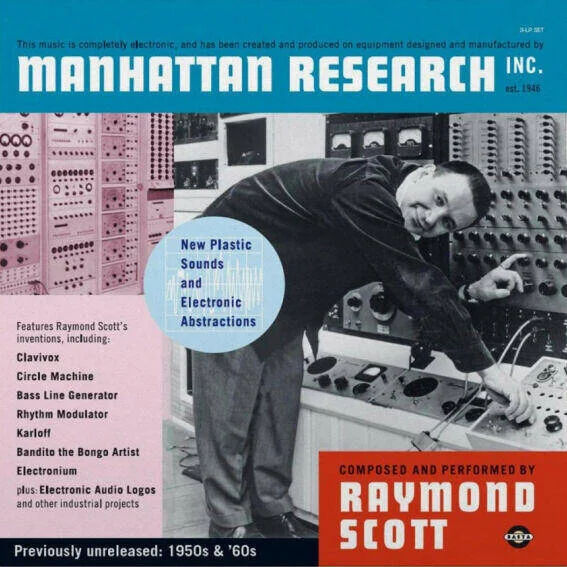
But SSFB couldnt prepare the world for the exotic artifacts found on Bastas 2-CD set, Manhattan Research Inc. MRI, first issued on Basta in 2000, contains 69 tracks recorded from 1956 to 1969over two hours worth of Scotts groundbreaking electronic work in adult dimensions. Forays into abstract musique concrete are heard alongside film soundtrack collaborations with a young pre-Muppet Jim Henson, and pan-galactic sonics seemingly beamed down from hovering UFOs. In addition, MRI presents some of the first TV and radio commercials to feature electronic music.
Now, Music on Vinyl presents a new edition of MRI in a 3-LP set, including full track notes, a historical overview, and newly designed covers. The package contains an 8-page booklet, printed innersleeves and a free download coupon for the complete album. The first 1.000 copies of MRI are individually numbered and pressed on Red, White & Blue coloured vinyl.
The personnel on MRI consists of such Scott inventions as the CLAVIVOX, a keyboard Theremin that was later modified to produce an array of sounds similar to a synthesizer; the ELECTRONIUM, an instantaneous composition-performance console (conceived in the 50s, and developed in the 60s, used at MOTOWN in the
70s); polyphonic sequencers, including his CIRCLE MACHINE; the Rhythm Modulator; Bandito the Bongo Artist; and the Bass Line Generator; along with existing sound devices (e.g., the Ondioline and tone generators).
180 GRAM AUDIOPHILE VINYL
3 LP-SET / PRINTED INNERSLEEVES IN SLIPCASE
INCLUDES 8 PAGE BOOKLET WITH FULL TRACK NOTES AND A HISTORICAL OVERVIEW
FREE DOWNLOAD
LIMITED EDITION OF 1.000 COPIES ON RED (LP1), WHITE (LP2) & BLUE (LP3) COLOURED VINYL
INDIVIDUALLY NUMBERED
RAYMOND SCOTT HAD A HUGE INFLUENCE ON ENO, FRIPP, REICH, GLASS AND KRAFTWERK

Reviews
There are no reviews yet.