
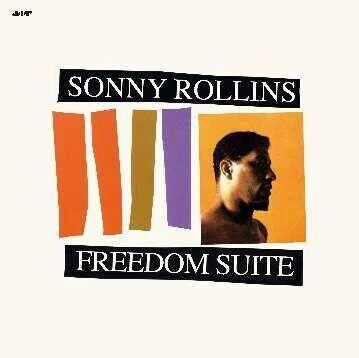
Description
By the mid-1950s. Sonny Rollins was already known as one of the most important jazz figures. Yet, even as his career continued to rise he was faced with the spectre of racism when he attempted to rent an apartment in New York City. Here I had all these reviews, newspaper articles and pictures, Rollins later said. At the time it struck me, what did it all mean if you were still a nigger, so to speak? This is the reason I wrote the suite. The suite refers to the famous composition Freedom Suite, a nineteen minute piece that featured Rollins, accompanied only by bass and drums. It was jazz musics first explicit extended instrumental protest piece, and its intentions were discussed in the intro to the original liner notes. The piece, a series of variations on fairly simple melodic material, caused a sensation, but Riverside Records decided it was too incendiary and pulled the recording, reissuing it under the title Shadow Waltz, the name of another track on the recording. Orrin Keepnews, the producer and part-owner of Riverside Records, wrote a new set of liner notes that stated Rollins intentions much less succinctly: This suite, then is about Sonny Rollins: more precisely, it is about freedom as Sonny is equipped to perceive it. He is a creative artist living in New York City in the 1950s; he is a jazz musician who, partly by absorbing elements of Bird and Monk and many others, has evolved his own personal music; he is a Negro. Thus the meaning of freedom to Rollins is compounded of all this, and, undoubtedly, much more. In one sense, then, the reference is to the musical freedom of this unusual combination of composition and improvisation; in another it is to physical and moral freedom, to the presence and absence of it in Sonnys own life and in the way of life of other Americans to whom he feels a relationship.
Keepnews is certainly not altogether wrong in his assessment, stated critic Marshall Bowden in an insightful article in All About Jazz, but he certainly pulls back some of what Rollins made very specific in his statement. Rollins statement that America is deeply rooted in Negro culture was, in 1958, a bold statement, to say the least. Yet he demonstrates it quite ably in his themes and the improvisations he unfurls during the course of the suite. Thelonious Monk, who was extremely influential in Rollins development, told the saxophonist to play the melody, not the changes, and Rollins seems to have followed that advice well.

Reviews
There are no reviews yet.