
Description
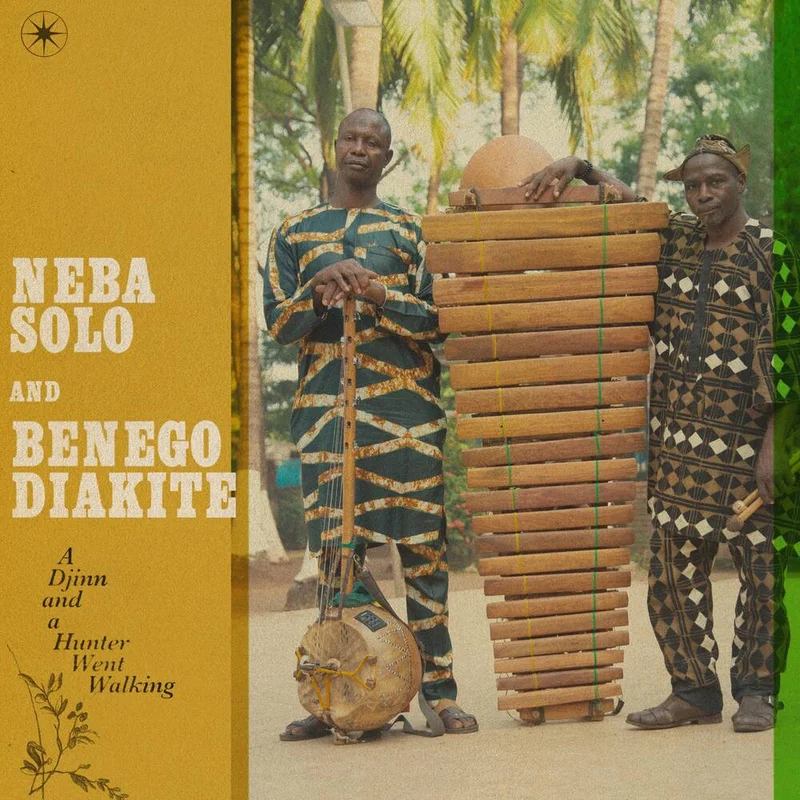
Nonesuch releases a new collaboration with its longtime partner, Nick Gold, former head of World Circuit Records, in the first of a series of releases: Malian balafon player Neba Solo and donso ngoni player Benego Diakités A Djinn and a Hunter Went Walking, co-produced by Gold, Ousmane Haïdara, and Sonny Johns on Etoile Audio/Nonesuch Records. Further collaborations between Gold, whose new imprint is called Etoile Audio, and Nonesuch will be announced soon.
The musical conversation that became A Djinn and a Hunter Went Walking began more than a decade ago. Haïdara and Gold first thought of combining these two instruments from different Malian cultures while preparing to record the legendary vocalist Oumou Sangarés Seya for World Circuit. Despite their cultures geographic proximity, the instruments Neba Solo and Diakité play do not often interact: Neba Solo is from Kenedougou, where the balafon was traditionally played in the fields to inspire farmers, and Diakité is from the nearby Wassoulou region, where the culture revolves around hunting. Gold had heard a balafon player in a Bamako restaurant and immediately thought the sound of the instrument might complement Sangarés record.
They invited Neba Solo to the Seya sessions, where the rising bala star hit it off with the band, developing a strong musical rapport with Diakité, a donso ngoni veteran. Sensing chemistry bubbling through ad-libbed music the two played warming up, Gold and Haïdara encouraged the two to explore further, and the session that became A Djinn and a Hunter Went Walking was arranged. Neba Solo brought a balafon he had customized with an extended bass register, and Diakité brought his deepest donso ngoni.
As Ingrid Monson explains in her album liner note, which is drawn from her forthcoming Oxford University Press book the Voice of Kenedougou: Neba Solo and Senufo Sensibility in Malian Music, Because the traditional songs they recorded were widely known in Mali, Haïdara at first planned an entirely instrumental duet album (to which Malian aficionados could hear the words in their heads). One night soon after, in the same courtyard, Haïdara played the recordings to Nick Gold on a pair of huge speakers. He was blown away. To create some variety over the course of an album, they decided to add touches of vocals and percussion. Neba Solo was inspired and made full vocal and percussion arrangements for every song. This in turn inspired an invitation to the English musician Sonny Johns, who added touches of strings, mellotron, guitar, and bass. Contributions were made in one country that inspired further additions in the other, a process which flowed easily into this unique album.
With this release, Neba Solo and Benego Diakité, long known as musicians musicians in Mali, step into the spotlight, joining a long line of their fellow Malians who have received worldwide attention over the past several decades including Salif Keita, Ali Farka Touré, Toumani Diabaté, Oumou Sangaré, Tinawiren, Songhoy Blues, Amadou and Mariam, Rokia Traoré, and Fatoumata Diawara many of whom have worked with World Circuit and/or Nonesuch Records in the past.
Neba Solo (b. 1969), aka Souleymane Traoré, is the reigning master of the pentatonic Senufo balafon. He transformed the ancient bala tradition, designing and building a bigger bass instrument, incorporating it into larger ensembles including kit drums; introducing bass figures inspired by reggae and by composing new songs, he brought the music to a national audience. Raised in the farming village of Nebadougou, Mali, Neba Solos exceptional talent as a bala player, singer, and percussionist was recognized when he was a small child. Over the years his dynamic stage shows, many recordings, videos, and television appearances have established him as a major figure in Malian music.
Brehima Benego Diakité (b. 1965) was born and raised in the village of Siekorolé in the circle of Yanfolila in southern Mali, where he became a fixture in Wassoulou music, as a master kamel ngoni (youths harp) player. The kamel ngoni, invented by Allata Broulaye in the 1960s, was a secularization of the donso ngoni (the hunters harp), an instrument restricted to sacred events led by hunters. Its structure and tuning are identical to the donso ngoni, only tuned higher. The kamel ngoni became popular among the youth who gathered for entertainment and dancing, to hear ensembles that included singers, karinyan (scraper), bolon (bass harp), and soku (fiddle). In 1985, Diakité co-founded Oumou Sangares band in Bamako and was a crucial contributor to her revolutionary debut cassette Moussolou (1988). Over the next four decades, he remained Sangarés accompanist of choice as she became first a Malian, and then an international, superstar. Benogos deeply rooted Wassoulou kamel ngoni style was the signature sound of her band.
Reviews
There are no reviews yet.