Description
Bo Diddley was born Ellas Otha Bates in December 1928 in McComb, Mississippi but was given the surname McDaniel when adopted by his mothers cousin. When he was six his adoptive family moved to Chicago and he began learning the trombone and the violin in a local church orchestra. When he saw bluesman John Lee Hooker playing at a concert he switched to guitar and began busking on street corners with a band called the Hipsters, who later changed their name to the Langley Avenue Jive Cats. By 1951 he was regularly playing at Chicagos 708 Club, where his repertoire was influenced strongly by Muddy Waters and John Lee Hooker.
There are many conflicting stories as to the origin of Bo Diddleys stage name. He claimed that others started calling him by the name, possibly as an insult, linked to the slang diddly squat meaning nothing at all. A diddley bow is a homemade one-stringed instrument and considering that Bo Diddley always played his distinctive rectangular guitar, this could possibly be a contributory factor.
After recording and submitting some demo tracks in 1955, Diddley was signed to Chess Records subsidiary label Checker. He recorded Bo Diddley and Im A Man for the label and when the single was released in March of that year it shot to the top of the R&B charts. The lyrics of the A-side were based on the traditional Hush Little Baby.
The rhythm of the song is so distinctive that it has become known as the Bo Diddley beat. Very similar to hambone, a dancing technique involving slapping parts of the body to create a rhythm, it also sounds a little like the shave and a haircut, two bits rhythm. It was also clearly influenced by Latin American dances such as the rumba which, in turn, were derived from African dance rhythms. Bo Diddley often used claves and maracas in recordings of his songs, which also serves to highlight the Latin influence on his music.
So hypnotic is this rhythm that it has cast its influence on many rock and pop songs ever since. The list is a remarkable one and includes Buddy Hollys 1957 track Not Fade Away (also covered by Diddley fans the Rolling Stones in 1964), Elvis Presleys His Latest Flame (1961), the Strangeloves I Want Candy (1965), the Whos Magic Bus (1968), Guns N Roses Mr Brownstone (1987), George Michaels Faith (1988), U2s Desire (1988) and Primal Screams Movin On Up (1991).
Bo Diddley has been nicknamed The Originator at various times in musical history for the role he played in influencing many genres of rock an d blues. Clearly his influence on the genesis of Fifties rocknroll was a key one. Even though he may not have had the chart success of his rival, Chess (near) labelmate Chuck Berry, the part he played in the R&B + Rockabilly = Rocknroll equation was pivotal. He has also been claimed by a new generation of rappers and hip-hop musicians as the originator of their style.
He often played just one chord throughout an entire song, so the music was entirely reliant on the all-pervasive rhythm and the spoken or shouted lyrics. These were derived from the call and response of gospel music and often from some other very unlikely sources. The Hush Little Baby origins of Bo Diddley have already been mentioned; likewise, his track Hey Bo Diddley, released in 1957, is based on the nursery rhyme Old McDonald Had A Farm!
Bo Diddley never achieved the chart success other rocknroll pioneers enjoyed, and the origin of this may lie in an incident which occurred on US TVs Ed Sullivan Show in 1955. He was booked to appear on the show and was heard backstage casually singing the Tennessee Ernie Ford song Sixteen Tons. Sullivan then instructed him to sing the song on his show. There followed a misunderstanding where Diddley saw the words Bo Diddley and Sixteen Tons on a cue card, so began with Bo Diddley instead. This infuriated Sullivan, who apparently told the musician he wouldnt last six months and that he was the first coloured boy to double-cross him. Bo Diddley was a great storyteller and doubtless embellished this story over the years, although he always maintained he never intended to double-cross Sullivan.
Diddley continued to have single hits through the Fifties and early Sixties and achieved fame in the UK when, in 1963, he starred in a concert tour with the Everly Brothers and Little Richard. The Rolling Stones, still hardly known outside London at that time, appeared as a support act on the same tour.
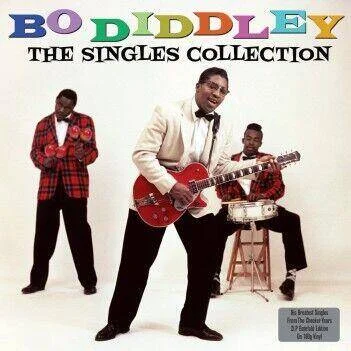
Bo Diddley was truly a one-off who played an often-underestimated role in the history of rocknroll. Enjoy this compilation of his singles that proves it.
Reviews
There are no reviews yet.