Description
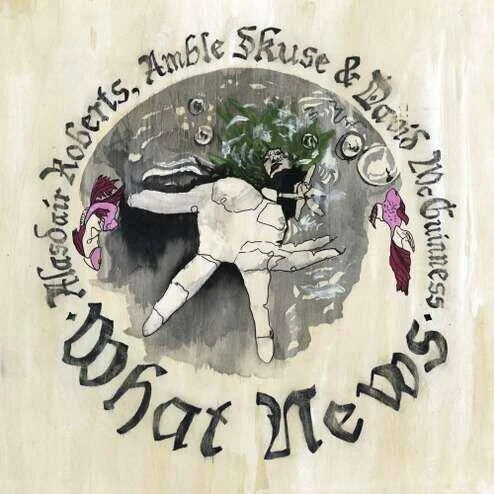
For his twelfth solo album What News and his fourth album focused exclusively on the performance of traditional songs, Alasdair Roberts has chosen a typically unusual and eclectic pair of collaborators: Amble Skuse and David McGuinness.
On past albums No Earthly Man and Too Long In This Condition, Alasdair relied on his deep connection to the songs to anchor often exploratory arrangements that would locate the hundreds-years-old songs in a contemporary milieu. The resulting works are magnetically compelling and have been powerfully acclaimed down the years. For his first project in this vein since 2010, Alasdair was inspired by Scottish singers such as Jeannie Robertson, Lizzie Higgins, Duncan Williamson, Elizabeth Stewart and Sheila Stewart. He had a desire to sing and not so much to play, so he asked early music scholar and Concerto Caledonia director David McGuinness (a previous collaborator) to play keyboard accompaniment for these songs, upon which Alasdair would not be playing guitar.
This was provocative: Alasdair was counting on David to respond to a counter-intuitive suggestion with surprising, idiosyncratic playing. David was challenged but up to the task. He started with the choosing of appropriate instruments, which he found at the University of Glasgow: an 1844 grand pianoforte and a Mozart-style fortepiano of relatively recent vintage the types of instrument they call in Holland brown pianos (as opposed to the black sound of the modern Steinway). To these, David added his own circa-1920 Dulcitone, a Glaswegian keyboard that plays tuning forks instead of strings.
During the process of developing the arrangements, David hit upon an idea for an additional collaborator: sonologist Amble Skuse, whose work involves interactive, electronic performance treatments. This provided a third plane for the project and thus triangulated, they were able to crystallise an approach involving a very open soundstage: Davids keyboard, Alasdairs vocals and Ambles structural soundscaping. This makes for beautiful and driven music that has no analogue in Alasdairs catalogue for while he has consistently pursued the dynamic fusion of songs from hundreds of years ago in a modern and progressive context, he hasnt worked with a keyboard as the central instrument. The beauty of the conception is evident throughout, with immaculate engineering capturing all the nuances of David and Ambles work. Alasdairs singing embodies previously unheard capacities in his ever-evolving catalogue of song and he also contributes a powerful guitar obbligato and solo on The Dun Broon Bride no doubt in response to the fine work of his collaborators.

Reviews
There are no reviews yet.